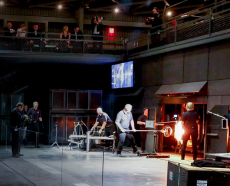
Remembering Tom Dimitroff
Oct 1, 2026
Issue 3801
EAGLES, STEUBEN, AND A PASSION FOR CARDER

With the passing of Tom Dimitroff, we have lost not only a friend but a teacher and historian with rich knowledge of Frederick Carder and Steuben Glass. Tom generously shared this knowledge with collectors across decades.
Many of our members will remember first meeting Tom at a Friends of Carder Symposium in Corning. For some, that introduction led to visits to his home, long conversations about Carder and Steuben, and the opportunity to learn from someone who had spent years studying the glass and the people who made it.
One friend recalled being fortunate enough to make weekend trips to Corning to visit both Bob Rockwell’s store and Tom’s home, where hours could be spent discussing “Carder lore.” Another remembered meeting Tom in 1974, when he began working at the Corning Glass Museum. A young collector himself at the time, he remembered Tom taking him under his wing and mentoring him “with great enthusiasm.” Their friendship lasted for decades.
Tom’s enthusiasm for sharing what he knew extended well beyond those personal conversations. In 2003, during the celebration of Steuben’s 100th anniversary, he wrote a series of articles for the Corning Leader exploring the history, artistry, and techniques of Steuben Glass. One of those articles seems particularly appropriate to revisit now. It concerned eagles, and Frederick Carder’s cire perdue eagles were among Tom’s favorites.
Tom used two Steuben eagles, one from the Carder era and another from the modern era, to demonstrate something remarkable: Although created many decades apart, the two were produced using essentially the same ancient technique.
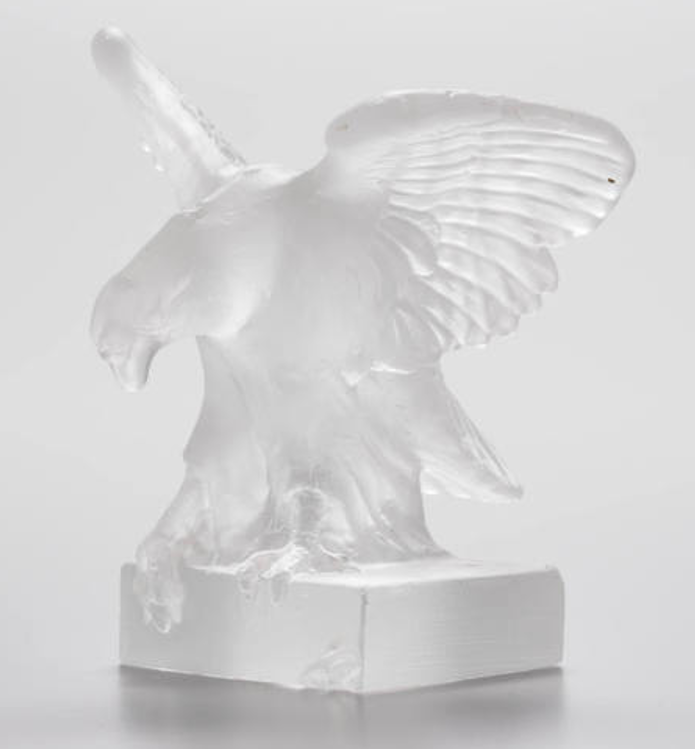
Carder called the process cire perdue, or “lost wax.” It was an extraordinarily complicated method of casting glass. Carder first created his object in clay or modeling wax. From that original sculpture, a series of molds was made, eventually producing a detailed wax replica. That wax model was encased in a heat-resistant material and then melted away, leaving behind a mold containing every detail of the original sculpture. Glass rods or pieces of glass were placed inside, and the mold was heated until the glass melted. After cooling and annealing, the mold was broken away to reveal the finished glass sculpture.
As Tom explained, Carder was not the first glass artist to experiment with cire perdue. European artists including René Lalique, Henri Cros, François-Émile Décorchemont, and Gabriel Argy-Rousseau had also explored the technique. But Carder took the process in his own direction and used it to create some extraordinary works.
Tom then brought the story forward to modern Steuben and designer David Dowler’s interpretation of the American eagle.
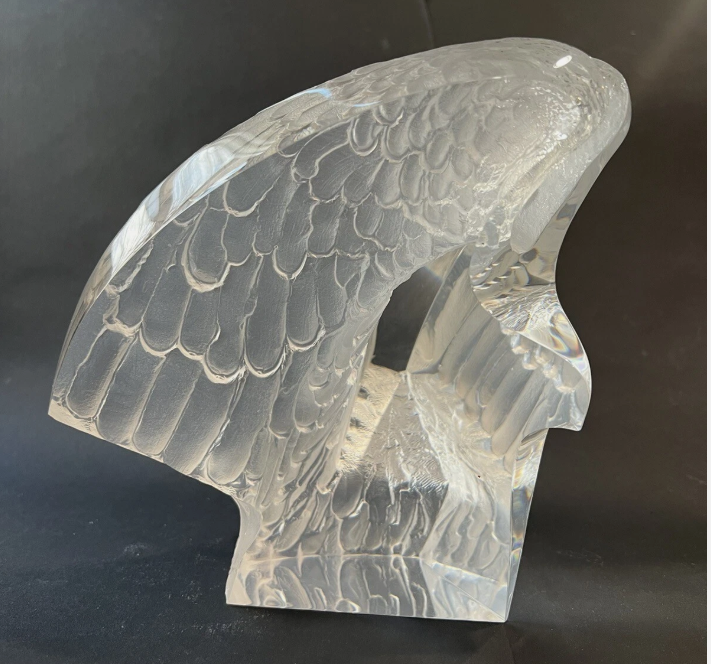
Dowler began with a small sketch and created a model in clay and wood. From this, a flexible mold was made and filled with molten wax. The resulting wax model was then surrounded by a material capable of withstanding high temperatures. Once hardened, the wax was melted away, leaving a negative mold into which a precisely measured amount of molten Steuben glass was introduced.
The similarities to Carder’s process were striking, but Tom also pointed out the differences. Modern mold materials were more advanced, and the clarity of the later Steuben glass allowed the process to produce a casting with fewer internal imperfections. Dowler also took advantage of the optical qualities of Steuben glass. His abstract eagle was designed to convey strength and majesty, with feather patterns placed on only one surface so that reflection and refraction caused the pattern to appear duplicated within the glass.
That was characteristic of Tom’s way of telling the Steuben story. A single object could become a doorway into glassmaking techniques, designers, history, and the continuing relationship between Carder’s Steuben and the Steuben that followed him.
For those fortunate enough to know Tom personally, there was something else behind all that knowledge: His willingness to share it.
Collectors could ask questions, compare pieces, discuss discoveries, or simply sit and talk about Carder and Steuben. Those conversations helped turn an interest in glass into friendships that lasted for decades. Tom’s knowledge was important, but so was his enthusiasm for passing that knowledge along. Revisiting one of his articles reminds us of both.
The eagles Tom admired are beautiful objects in their own right. Today they also provide a fitting way to remember him through Frederick Carder, through Steuben, and through the glass that Tom spent so many years studying, enjoying, and helping the rest of us understand.
An obituary has been published in the Corning Leader here. Services for Tom Dimitroff will be held on October 10th, 2026 at 1:00 p.m. at Christ Episcopal Church in Corning, New York. More information will be forthcoming.
Gazelle Gazette Archive



Carder Steuben Glass Association
22-23 September 2027