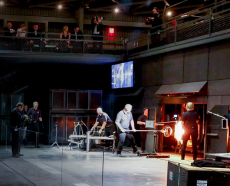
Learning Something New About Wisteria
Dec 10, 2025
Issue 3773
As part of our 2025 Symposium activities, attendees enjoyed a special guided tour of the Corning Museum of Glass exhibition Brilliant Color. This vibrant exhibition explored how glass designers and manufacturers of the late 19th and early 20th centuries created unprecedented, richly saturated colors in glass—colors that had never been seen before. The exhibition featured interactive displays and was accompanied by a fully illustrated catalog. The catalog featured essays from Amy McHugh, glass historian James Measell, and Amy J. Hughes.
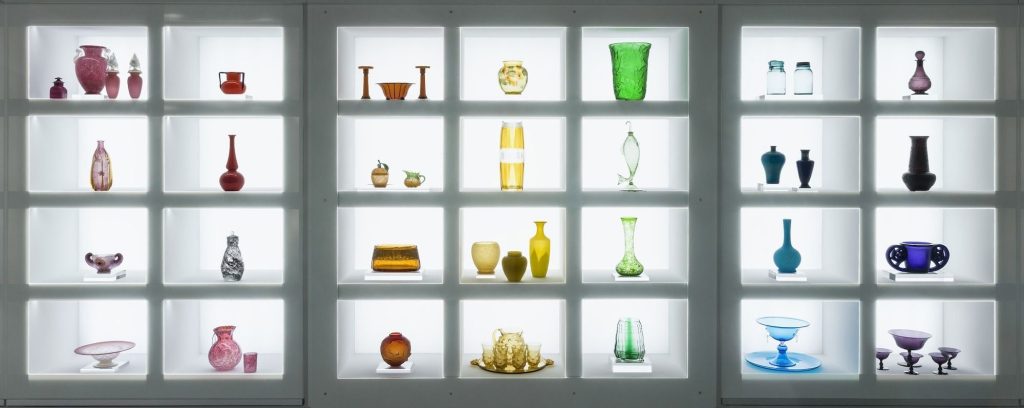
Brilliant Color showcased pieces from across the color spectrum by leading artists and glassmaking firms of the era, including Tiffany Studios, Lalique et Cie, and Steuben Glass. Frederick Carder’s Steuben creations were prominently represented, much to our delight.
The exhibition was organized by Amy McHugh, Curator of Modern Glass at CMoG. Our group tour was led by Amy J. Hughes, Assistant Curator, whom many will remember from her engaging presentation at our 2024 symposium on Leo Moser’s rare earth glass. Amy Hughes made the tour exciting and energetic.
Pushing the Boundaries of Color and Technique
Many of the glass designers featured in the exhibition were trained not only as artists but also as chemists. Their dual expertise allowed them to experiment boldly, developing new formulas and processes that expanded the possibilities of color in glass. Innovations in applied decoration and iridescent surface treatments further enabled glassmakers to produce complex color effects. Inspiration came from an array of artistic traditions—Chinese porcelain, carved agate, and other decorative arts—as well as from forms and hues found in nature.
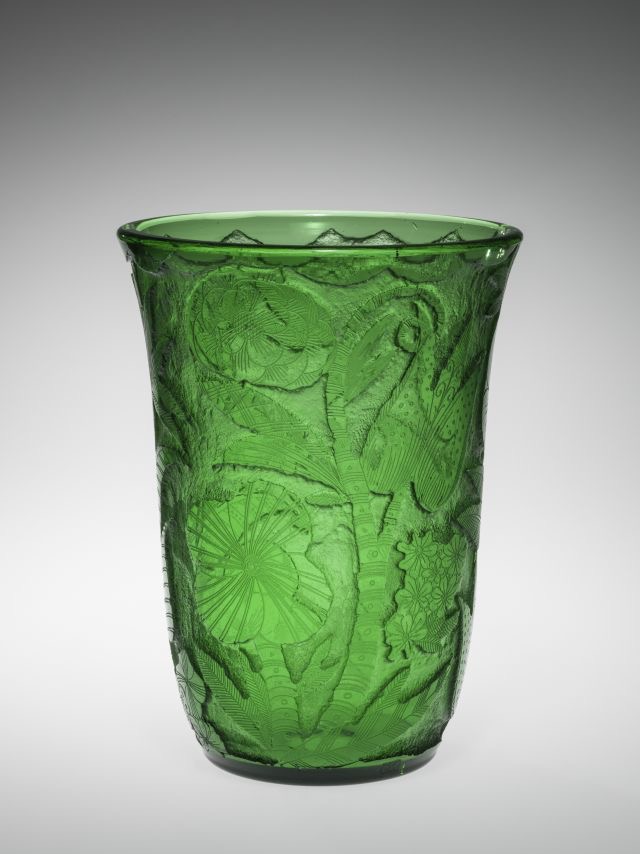
Understanding Dichroic and Metameric Glass
One of the displays in the exhibition explained color-changing properties in glass that depend on lighting conditions. While we are familiar with the term “dichroic glass” many of us learned a new term — “metameric glass.” And we were especially surprised to learn that we had perhaps been misusing the term “dichroic” when talking about Frederick Carder’s Wisteria glass.
The Brilliant Color exhibit explained these two terms:
- Dichroic Glass: Glass that appears as one color in reflected light and another in transmitted light.
- Metameric Glass: Glass that changes color depending on the light source.
The differences between these terms might best be understood by looking at some examples.
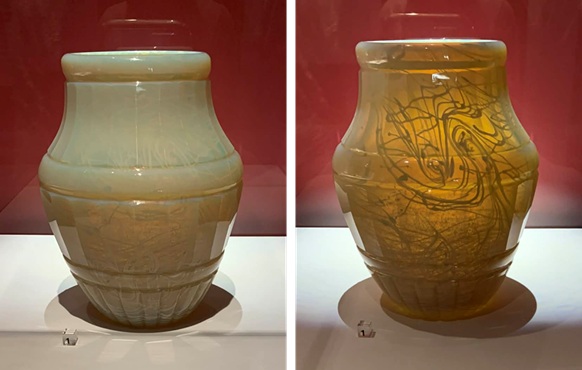
The Louis Comfort Tiffany vase (below) was part of the Brilliant Color exhibition and is an example of dichroic glass. When light shines on this vase from the front (left) it reflects a cream color back to our eyes. But when light shines from behind (right) the glass appears to show a green/amber color.
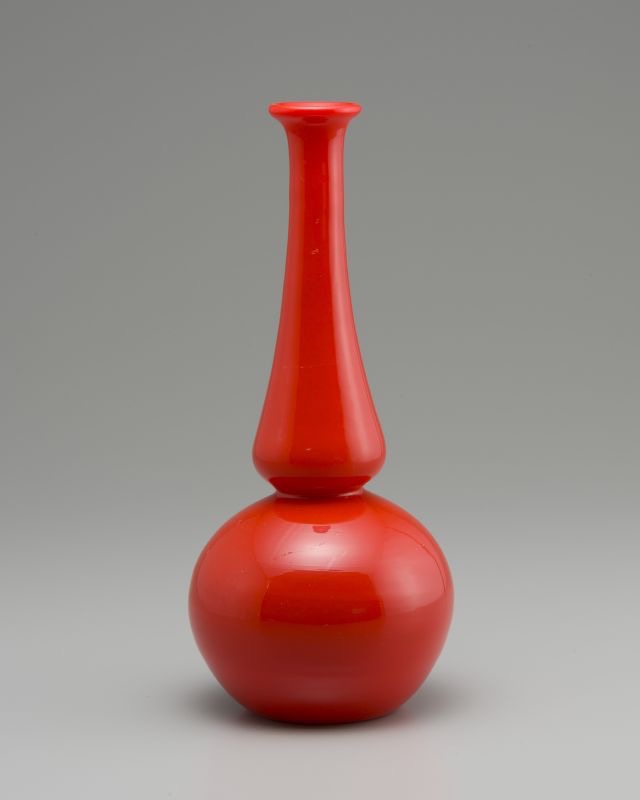
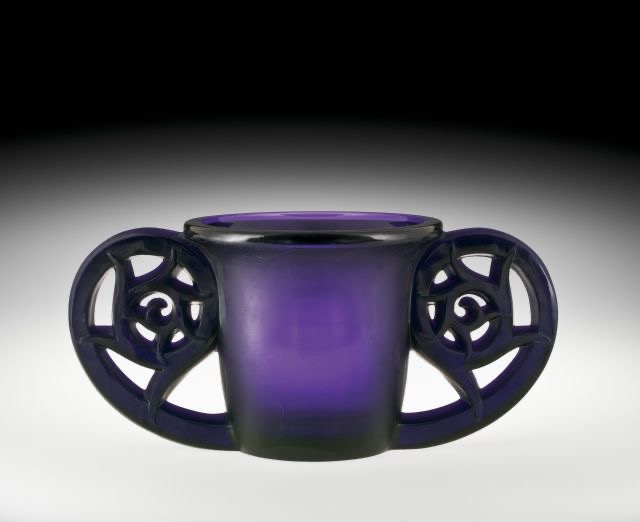
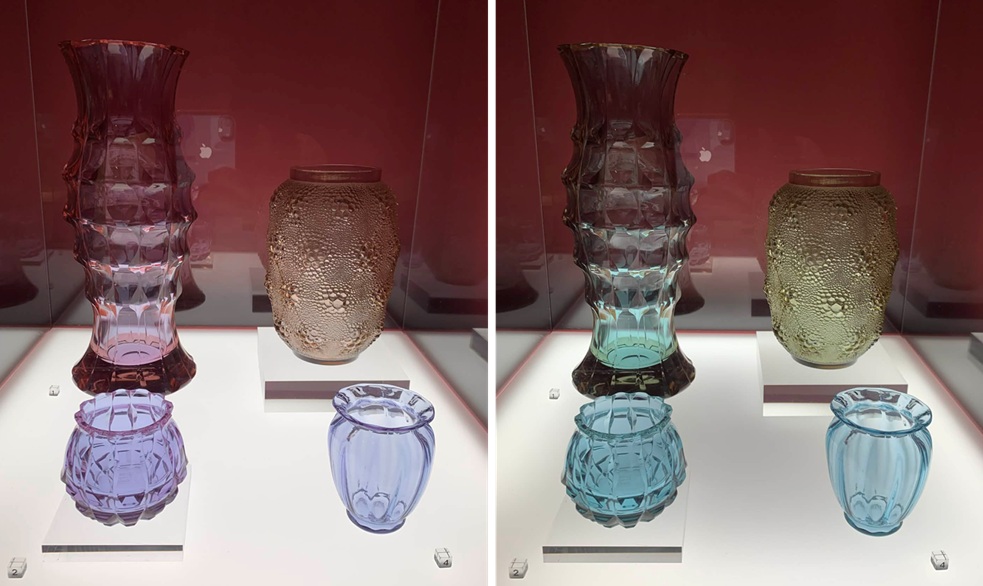
Several vases highlighted during the tour were examples of metameric glass. The examples below were made by Moser, Lalique, and Steuben. The vessels all shift in appearance under different lighting sources: Sunlight (left) versus indoor lighting (right), for instance. This effect is achieved by adding rare earth elements to the glass batch before melting.
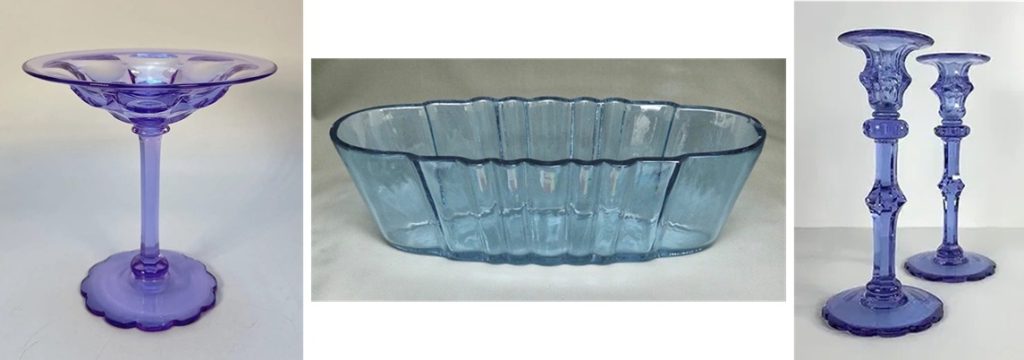
Until recently, Frederick Carder’s Wisteria glass was commonly described as dichroic. Tom Dimitroff’s Frederick Carder and Steuben Glass characterizes it as “Carder’s dichroic blue-to-lavender glass, which imitated the gemstone alexandrite…a difficult color to make, with very little surviving today.” With our new understanding of these terms, perhaps we can now more accurately classify Carder’s Wisteria as metameric. We’re always learning!
SAVE A TREE — RENEW TODAY

Thank you to all who have renewed your Carder Steuben Glass Association membership already. We plan to mail out 2026 renewal envelopes soon. We would love to save on mailing costs (and save a tree) by having as many members as possible renew their membership electronically before this time. It’s fast and easy! Just click here to visit the Membership section of the CSGA website. You can submit the membership form electronically and pay the annual dues through Paypal or by mailing a check. We greatly appreciate your support. Please renew today!
Gazelle Gazette Archive



Carder Steuben Glass Association
18-19 September 2026