Two Cats, Two Eras
Feb 13, 2026
Issue 3778
STEUBEN GLASS THROUGH THE EYES OF THOMAS P. DIMITROFF
In 2003, as part of the centennial celebration of Steuben Glass, Corning historian and noted Steuben expert Thomas P. Dimitroff authored a series of articles for The Corning Leader. These thoughtful essays offered a retrospective look at Steuben across the decades, drawing insightful comparisons between the eras of Frederick Carder and Arthur Houghton.
Tom generously shared nine of these articles with our organization, and they are now available for viewing on our website. This issue of the Gazette highlights the fourth article in the series, dated June 29, 2003, in which Tom juxtaposes two very different, but equally compelling renditions of a cat.
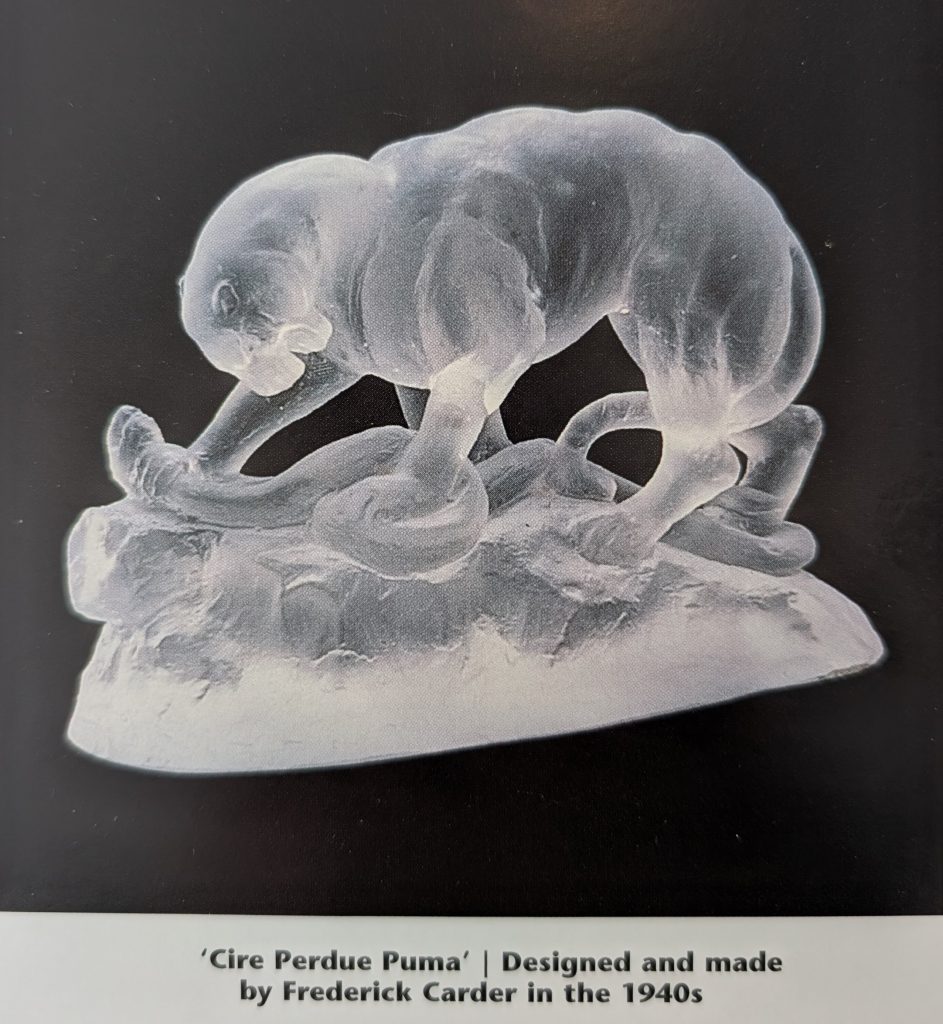
In 1932, following his removal as director of Steuben, Frederick Carder became art director at Corning Glass Works. He was given an office on the fifth floor of Building 21, then Corning’s headquarters. Before long, Carder transformed much of that space into a working studio, complete with a glass-melting furnace of his own construction.
Encouraged by Dr. Eugene Sullivan, co-inventor of Pyrex glass and vice chairman of Corning, Carder resumed his lifelong habit of experimentation. During this period, he turned his attention to perfecting an ancient metalworking method known as the cire perdue, or “lost-wax,” process, adapting it for use in glass.
Carder succeeded brilliantly. His sculptural figures, including a striking puma entwined with a snake, testify to the beauty and technical mastery of these works. Produced from the late 1930s through the 1950s, Carder’s cire perdue pieces are all the more remarkable given that they were both designed and crafted by Carder while he was in his seventies and eighties.
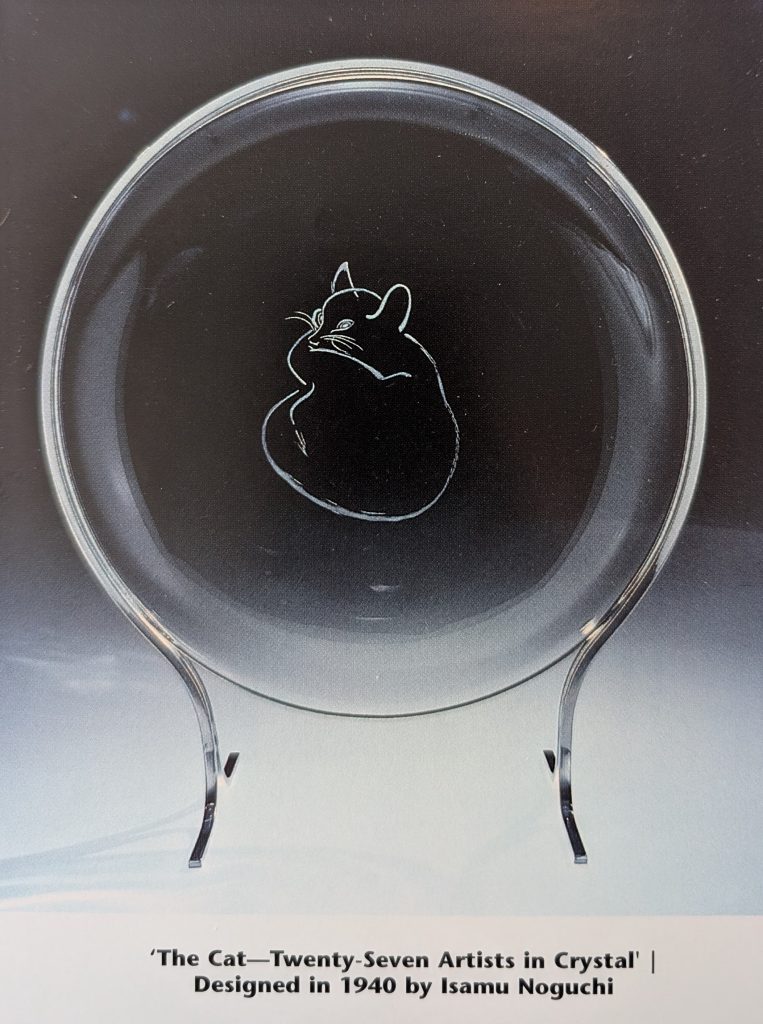
To represent the modern era, Dimitroff turned to a very different feline: The Cat, designed in 1940 by Isamu Noguchi as part of Steuben’s celebrated Twenty-Seven Artists in Crystal series.
Although Steuben produced many cat forms over the years, none achieved greater acclaim than Noguchi’s elegant, fluid design. Its creation stemmed from a fortuitous artistic connection. While in Paris in 1937, architect John Gates, recruited by Arthur A. Houghton, met Henri Matisse, who was intrigued by the possibility of using engraved Steuben glass as a new artistic medium. Inspired, Gates invited not only Matisse but 26 additional renowned artists to contribute designs. The resulting roster included Thomas Hart Benton, Salvador Dalí, Georgia O’Keeffe, and Noguchi. Noguchi’s simple yet expressive cat engraved on a Steuben crystal plate, quickly became one of the most beloved designs in the series. The engraving was executed by Peter Schelling, who beautifully captured the flowing lines of Noguchi’s original drawing. Only six plates were initially produced. When all 27 pieces were completed, the exhibition Twenty-Seven Artists in Crystal opened at the Steuben shop in New York City in January 1940. It proved to be one of the most successful exhibitions in Steuben’s history. As Mary Madigan later reported, “On Valentine’s Day, attendance grew so large that the doors of the Steuben building had to be locked several times a day while lines of people waited on Fifth Avenue.”
Through these two cats, Carder’s sculptural cire perdue puma and Noguchi’s engraved feline, Thomas Dimitroff offers a lens through which to view Steuben’s evolution.
UPCOMING MEMBER ZOOM MEETING

Save the date for our next CSGA member gathering! We’ll be meeting virtually via Zoom on Sunday, March 22, 2026 from 3:00-4:30pm EDT. We will enjoy a short presentation and then have “Show and Tell” where we invite each member to share the story behind a treasured piece from their collection. More details will be shared in the coming weeks, but please mark your calendars. We hope to see you there!
CMOG MEMBERSHIP CARDS
Your active membership in the Carder Steuben Glass Association also gives you membership to the Corning Museum of Glass, providing free admission, invitations to special events, and discounts at the CMoG store. CSGA members who have renewed for 2026 should now have received updated CMoG membership cards. CMoG has largely moved to electronic cards, so check your online “wallet” for the digital card which should now be good through January 31, 2027.
Haven’t renewed your CSGA membership? It’s not too late! Renewing online is fast and easy through our website. Just click here for more information and to renew. Thank you for your support!
Gazelle Gazette Archive



Carder Steuben Glass Association
18-19 September 2026