The Northwood Vase Revisited
Jan 16, 2026
Issue 3777
Scholarship, Debate, and the Legacy of Ed Bush
The silver overlay “Northwood vase” has long held a special place in Carder scholarship not only for its beauty and rarity, but for the thoughtful debate it inspired within our community. With the passing of Ed Bush last year, it feels especially fitting to revisit this remarkable object and to acknowledge Ed’s lasting contribution to our understanding of it.
The vase first became the subject of intense discussion in 2007, when it appeared at Bonhams as part of the estate of the late and much-admired Steuben dealer Joan Miller. Thought to have been created around 1901 while Frederick Carder was still at Stevens & Williams, the vase was engraved as a presentation piece to John Northwood. Its inscription—“Frederick C. Carder”—immediately raised questions. At the heart of the controversy was that seemingly simple middle initial. Carder was widely believed not to have used a middle initial during his American years, having immigrated in 1903 and later co-founding Steuben. The presence of a “C” on an English-period piece prompted speculation: Was this evidence of a forgery? Did Carder sign differently in England? Or was something else at play?
What followed was a vigorous, sometimes spirited exchange among collectors, scholars, and curators. Correspondence with the Corning Museum of Glass, including Jane Spillman (then Curator of American Glass) underscored how questions of attribution and provenance can be both challenging and fascinating. While the vase did not neatly fit expectations for either English or American silver overlay, there was broad agreement that it represented a unique moment in Carder’s career and deserved serious consideration, perhaps even a place in a museum collection. Amid this swirl of opinion, Ed Bush did what he did best: He went to the sources. Spending countless hours at the Rakow Library and poring over documents, signatures, and records, Ed approached the mystery not with conjecture, but with methodical care. The result was his superbly researched article, “The Wayward ‘k’ of Frederick Carder’s Signature,” published in the Glass Club Bulletin of the National American Glass Club.
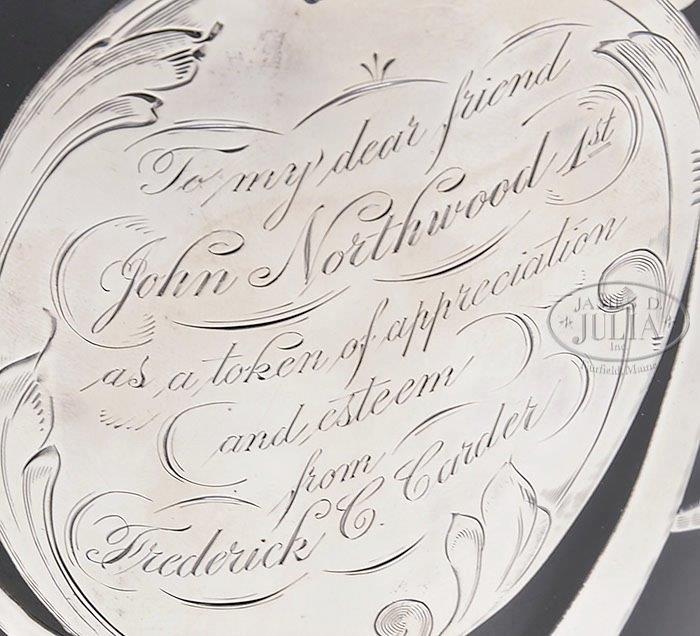
Ed’s insight was elegant in its simplicity. Examining Carder’s handwriting, and particularly his naturalization signature, Ed observed that the flourish at the end of Carder’s “k” could easily be mistaken for a “C.” His conclusion was that the engraver of the silver overlay, working from a handwritten signature supplied by Carder himself, likely misinterpreted that flourish as a middle initial. No forgery, and no hidden agenda. Just a human error, entirely plausible and historically grounded.
Subsequent evidence suggested that Carder occasionally did use his middle name, Caleb, or its initial, both in England and, at times, in the United States. References to “Frederick C. Carder” appear in design credits for Pyrex and in other archival materials, reinforcing Ed’s broader point: Carder’s use of his name evolved over time and context, guided by personal preference rather than rigid convention.
The story did not end there. When the Northwood vase resurfaced at auction in 2013, it sold for over $13,000, again reigniting interest and discussion. Yet by then, the community had something it lacked in 2007: Ed Bush’s careful scholarship, which transformed uncertainty into understanding.
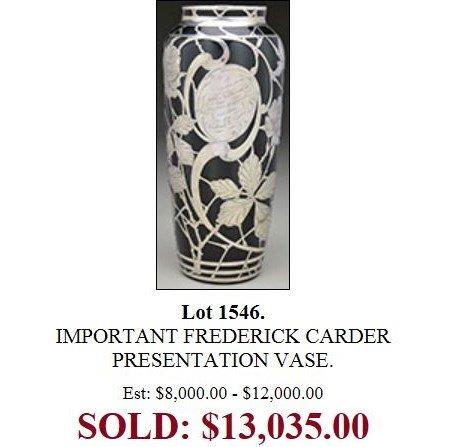
In the end, the Northwood vase is more than an extraordinary piece of glass. It is a reminder of why we debate, research, and question—because history is rarely tidy, and truth often emerges only through patience and collaboration. Ed Bush embodied that spirit. His work did not simply resolve a mystery; it modeled how serious scholarship should be done. As we remember Ed, we do so with gratitude for his intellect, his generosity, and his unwavering commitment to getting the story right. His research continues to inform our discussions, and his voice remains part of the conversation every time the Northwood vase is mentioned. That is a legacy any scholar would be proud to leave.
HAVE YOU RENEWED?
As we adjust to writing “2026” as the date, it’s also a reminder that we have entered a new membership year. If you haven’t had a chance yet to renew your membership for this year, please consider doing so now. Your dues of $35 for a regular membership or $55 for a two-person household will keep you as active members through December 31, 2026. We greatly appreciate your support!
You can easily renew your membership on the CSGA website here. If you have any questions, please feel free to reach out to our CSGA Secretary, Sue Maynard, at secretary@steubenglass.org. Thank you!
UPCOMING AUCTIONS
We wanted to call attention to two upcoming auctions, each of which will feature items from the collections of some dear friends of the club. Perhaps you’ll want to add some of these lovely pieces to your own collection?
- Jaremos Auction — January 21, 2026 will be offering several pieces from Mark Chamovitz’s glass collection.
- Cottone Auction — January 22, 2026 has a second installment of many pieces from Bill Melenbacher’s Carder Steuben glass collection.
Gazelle Gazette Archive



Carder Steuben Glass Association
18-19 September 2026